
Tim Wilson: Russia’s NTV channel, fake interviews and Zeynalova
 Foreign experts may now think twice before agreeing to give interviews to the Russian TV channels that address them.
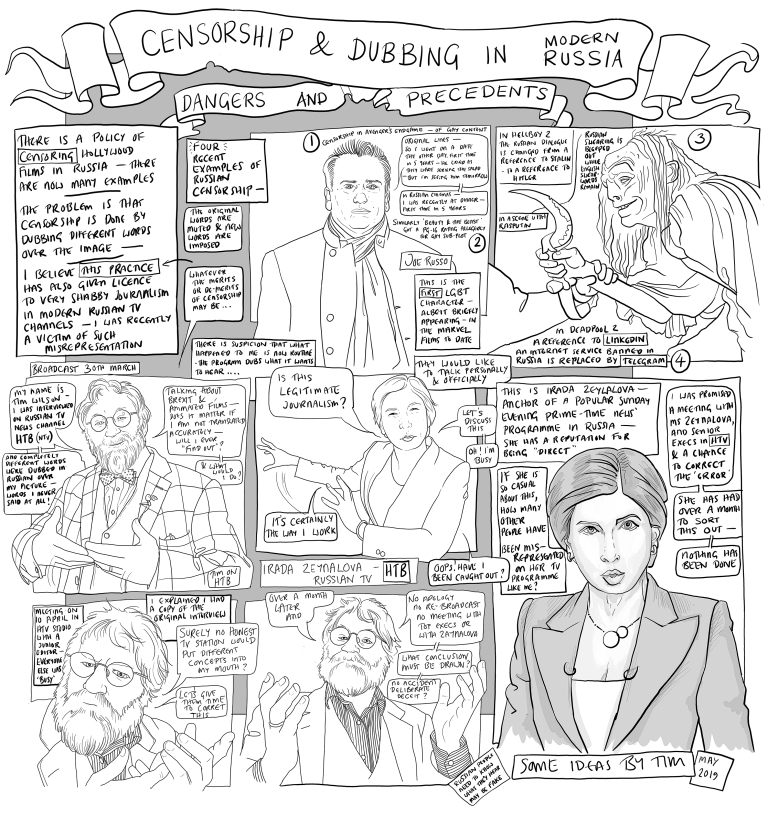
In two recent reports with British experts on Brexit and related issues, NTV, owned by the branch of the Russian state giant Gazprom, was caught in a creative dubbing that completely distorted the authors' words.
In particular, on March 31 this year, NTV's program Itogi Nedeli (Results of the Week) and its presenter Irada Zeynalova published a report with British expert Tim Wilson, a former conservative politician formerly a member of the UKIP, cartoonist, documentary filmmaker, theology teacher at universities in London, Oxford and Moscow.
Wilson gave an interview to NTV at his home in Midland, and after the report came out, he found a distortion of his words from the so-called "russian voice behind the scenes," about May and former Prime Minister David Cameron. From his own phone interview, Wilson notes that, although he had harsh remarks about May and her plans for Brexit, it did not coincide with the meaning in which his words were presented.
Professor Wilson contacted us to tell about his own experience with the NTV channel as a warning to others. "I would be very happy to talk about this again, especially to draw attention to this form of deception. It would be great to start a campaign to stop the practice of duplicating interviews and giving preference to subtitles, or allowing original voices to be heard under the double”.
Interview
BBC published a story about your concerns over a TV interview conducted by Irada Zeynalova which was dubbed with fake words when it was aired on Russia’s NTV channel. Tell us more about it, please.
I did a couple of interviews for NTV. The first was aired last autumn and the second in March 2019. While the first interview was specifically about propaganda, (ironically) I was still suspicious that what I said was not accurately dubbed by the editing team, and I asked for access to the original tapes. It was not granted, of course.
At the same time, I very much enjoyed meeting the cameraman who was both charming and efficient. As a film-maker myself, it was a joy to be interviewed by someone who really knew what he was doing. The same cameraman interviewed me the second time and was happy for me to record the process on my phone.
When that second interview, which was about Brexit, was aired, it was immediately clear that what I was dubbed as saying was completely different to what I actually said. And more than that, in the process of a 20-minute interview, I never came close to saying the words that were dubbed. Various excuses were later peddled by NTV, and I was offered a meeting with senior executives and with Miss Zeynalova herself. Instead, when it came to the meeting, I was given a cup of tea in the staff canteen and fobbed off with a junior producer.
When I learnt that others were telling a similar story about Zeynalova’s programme, but that nobody had evidence that what they were saying was being distorted, I was persuaded to come forward, particularly as NTV continued over a period of nearly 4 months, to make no effort to take responsibility for its specific actions or to properly address my wider concerns.
I should add that they were much quicker to ask me to take down a video I had posted that showed the broadcast interview next to my recording of the original.
In the end, what I said and what I was dubbed as saying is not very important. I am not a senior politician or a world leader, but the way NTV dealt with the problem made me more concerned. Their casual approach to duplicity is what this story has revealed and it is something that needs to be called out. If it can happen to me, it can happen to more important people as indeed, I learnt it allegedly has.
I made a few recommendations to the programme and I would be delighted if they took the initiative and led the way to cleaning up Russian TV broadcasting. There must be a degree of accountability and greater public responsibility but I made one very practical suggestion: namely, to ensure that all foreign interviews are, henceforth, subtitled and not dubbed, or if there is to be dubbing, then the original words must still be audible. The use of loud music and the suppression of the original audio is simply dishonest and disrespectful. To put this in context: in most countries, the only films that are today dubbed in such a way as to completely erase the original audio are intended for children alone. To treat an adult audience, therefore, watching a news' programme on Russian TV to the sort of dubbing reserved elsewhere for “Bambi” and “Masha and the Bear" is to treat that Russian audience with contempt. She may not be aware, or she may not indeed to do so, but the simple reality is this: Irada Zeynalova is looking down on her audience- she is treating adults exactly like children. It has to change.
Do you think there are a lot of distortions on federal channels in Russia?
I only started to check the distortions on Russian media after I became suspicious that I had been falsely dubbed. I was quite surprised to find that there seems to be a spike. It is most evident in the re-dubbing of current feature films with Hollywood blockbusters like “Avengers: Endgame” for instance being effectively censored.
Is this connected with the traditions of Soviet propaganda? If so, how?
Soviet propaganda was significantly more sophisticated and more effective. The problem with this fake dubbing is that it is so clearly incompetent. If we go back even to the 1920s when Soviet Russia was pioneering the use of animation to get its messages across, that message was clear and over the next 50 years became increasingly sophisticated even if it was not altogether wanted or honest; the reason was because the technicians were also advancing the art form. The current spike in propaganda and news manipulation is ham-fisted and does nothing but point out the inadequacy of the technicians and in other words, simply exposes their duplicity.
There is a tendency to want to make a distinction between serious TV and entertainment, but they are just different parts of the same machine. As an educator and an artist, I know that I need to entertain if I am ever to engage an audience. This is not about being “less serious”. It is about committing to my chosen audience. In today’s world we need to be as well-versed in current political discourses as we are, for example in the rap lyrics of an accomplished performer like Oxxxymiron. To pretend that one subject is more serious than another is to live in an ivory tower and ignore basic reality. It is worth remembering that Harold Wilson endorsed the Beatles in the 1960s, and that Disney was hailed in the late 1930s as the developer of a serious art.
What threat do you see if tendencies to pass fake for real increase?
Technology is advancing. We cannot know if what we see is real or a result of photo manipulation. We cannot know if we are engaging with a genuine person on social media or if we are being “catfished”. We need to educate our children to be more careful and to get their news form multiple sources.
As for the incident of fake dubbing that happened to me at NTV- it also happened to a greater man, Professor Sir John Curtice. The difference is that I had proof. The threat, therefore, is not about what these people might do to me or to my reputation- it is that there is a growing use of dubbing as a form of censorship and fake news in modern Russia. If it can be done to me, it can be done to serious politicians and world leaders.
One hopes that the Russian audience is not so gullible, but the audience beyond Russia, which hears of these routine distortions in the media, will take an increasingly negative view and assume it is sanctioned by senior figures. This does not reflect well on any country.
What do you think about media literacy in the UK? The USA?
I think the British are media-literate, and fairly good at spotting what is fake. I cannot speak about the USA, but the political climate suggests a greater tendency to believe what is said on the media even if the term “fake news” is something coined and promoted as a concept by President Trump in the US!
What do you think about Brexit fake news?
There have been a number of fake stories associated with Brexit. As Brexit is an unknown, predictions about what will or will not happen after Brexit are purely speculative. This is very different to fake dubbing.
Why the UK is ‘Brexiting’? How it will affect the UK and the EU?
The then PM may well have felt threatened by the success of UKIP and the brilliant rhetoric of Nigel Farage. I think he was wrong to feel under any pressure at all as I also think the Remain campaign was wrongly pitched as a fight about money when it should have been about our duty to protect the EU from itself and to campaign towards reform. But the debate is effectively over, and we need to now look towards forging a new and lasting relationship with Europe and with our friends across the continent.
What is media literacy, why is it important and how can people spot fake news?
If it is “well-executed” fake news, then it is impossible to spot, but we are well-used to the fake news-stories that pop-up on April 1st and maybe that has given us a few years to get ready for this strange phenomenon.
How do we explain the difference between facts and opinions?
Today, there is less clarity, and facts are often coloured by the opinions of others. In the past, there was an understood editorial bias but today we often cannot always see the source of the story and it is harder to make a judgement. All stories are framed by the person who is telling them, and stories are also coloured by the context in which they are told or presented.
Does the national curriculum in the UK / worldwide equip children with the literacy skills they need to identify fake news?
As a teacher, I know that young people are savvy about what they read, see and what they are told, but we are moving into a world where even our opinions are dictated and this seems to me to be dangerous. We need to make every effort to teach children to express their own ideas, but to be prepared to back up these ideas with demonstrable facts, and to show their sources if possible.
How fake news can impact businesses both in Russia and in the West who wants to work together?
In a world where media moves very fast, we need to be ready with good stories and to circulate these as well as we can. We cannot suppress bad stories or fake stories however much we try. What we can do is to be ready with a positive image that is so robust that the negative rubbish has little effect.
How do you think relations between Russia and Britain will develop in the near future?
I am very fond of my Russian friends and students. I am confident that the relationship between the UK and Russia will grow. We have so much in common and I in my experience, we share a common way of looking at things. I am pleased that there are still so many Russian students who are being educated here in the UK. I would like to see more British students going to study in Moscow and St Petersburg- it is at this level that we can be most certain of a solid foundation for the future.

0 Comments